
How SARnet Works….
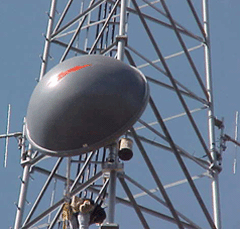
A SARnet local UHF repeater in your area is connected to other SARnet sites using a microwave radio network operated by the Florida Department of Transportation. The key to why SARnet works so well is that instead of using the internet, it uses dedicated bandwidth on a private microwave network.
How to use SARnet….
One of the great things about SARnet is that as an amateur radio operator you don’t have to do anything different to use SARnet. When you key your radio on the frequency of a local repeater connected to SARnet, you are automatically talking on SARnet, across the state of Florida. The only thing you need to do is keep track of the UHF repeaters in the state that are connected to SARnet so when you are traveling you will be able to find a SARnet repeater.
PLEASE NOTE: In general, long conversations and rag-chews are discouraged on SARnet. The network voice radio usage models that the FDOT is trying to investigate are short, efficient communications between users (think professional public safety radio transactions). In addition, during long conversations you are activating SARnet repeaters all over the state for an extended period of time, subjecting a state full of your fellow hams to rag-chews that they may not have an interest in. In particular, long local conversations are encouraged to move off of SARnet and onto another repeater that does not activate SARnet.
The SARnet team has given presentations on the system at Hamcation events. To see these presentations click on the links below:
How SARnet Really Works: the Details….
To help the FDOT identify what SARnet radio equipment is present at microwave tower locations, SARnet sites are categorized by the way they are hardwired to the FDOT SARnet network equipment at those microwave tower locations. This hardwire connection is accomplished in one of two ways at the microwave tower: via a control station radio or via a repeater radio itself. To distinguish between the two types of equipment, and use terms familiar to the FDOT, the SARnet administrators use the station class codes defined by the FCC in Form 601 to distinguish between the two types of radios. The FCC calls a repeater an FB2 and calls a control station radio an FX1. If you want to learn more about the station class codes, see page 78 of the FCC Form 601 instructions. The station class code for each SARnet site is given on the system status page, next to the site name.
Hardwiring to SARnet
via a Control Station (FX1)
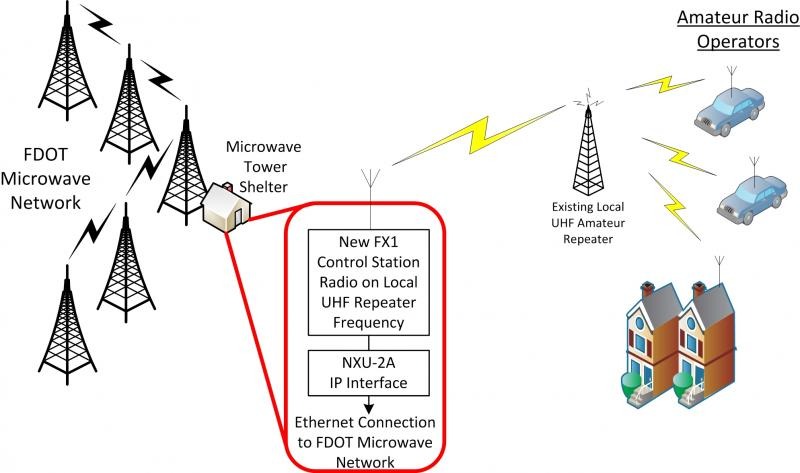
If an existing local repeater (FB2) is connected via radio to SARnet, the radio that is hardwired to the SARnet network equipment is a control station radio (FX1) operating on the existing local repeater’s frequency. Many of these FX1s are used GE MDX control station radios and a few are Hytera mobile MD782s. The FX1 is installed at an FDOT microwave radio shelter that is within the service footprint of the existing local repeater. The key to making an FX1 work is that the local repeater has to be configured to ensure that it does not send a CTCSS tone or DCS code when it IDs. That way, the FX1 on the SARnet won’t hear the ID and transmit it all over the state to other repeaters via SARnet. It is also preferred if the repeater does not send tone during squelch tails or courtesy beeps. This shortens the overall delay in the network for local listeners and ensures that all SARnet communications sound the same.
Hardwiring to SARnet
via a Repeater (FB2)
For most SARnet sites, UHF repeaters have been installed at FDOT microwave tower locations in order to support the needs of local emergency management and public safety agencies who work with amateur radio operators, including agencies like ARES. These FDOT-collocated repeaters (FB2s) are hardwired to the SARnet network equipment on the FDOT microwave network.